
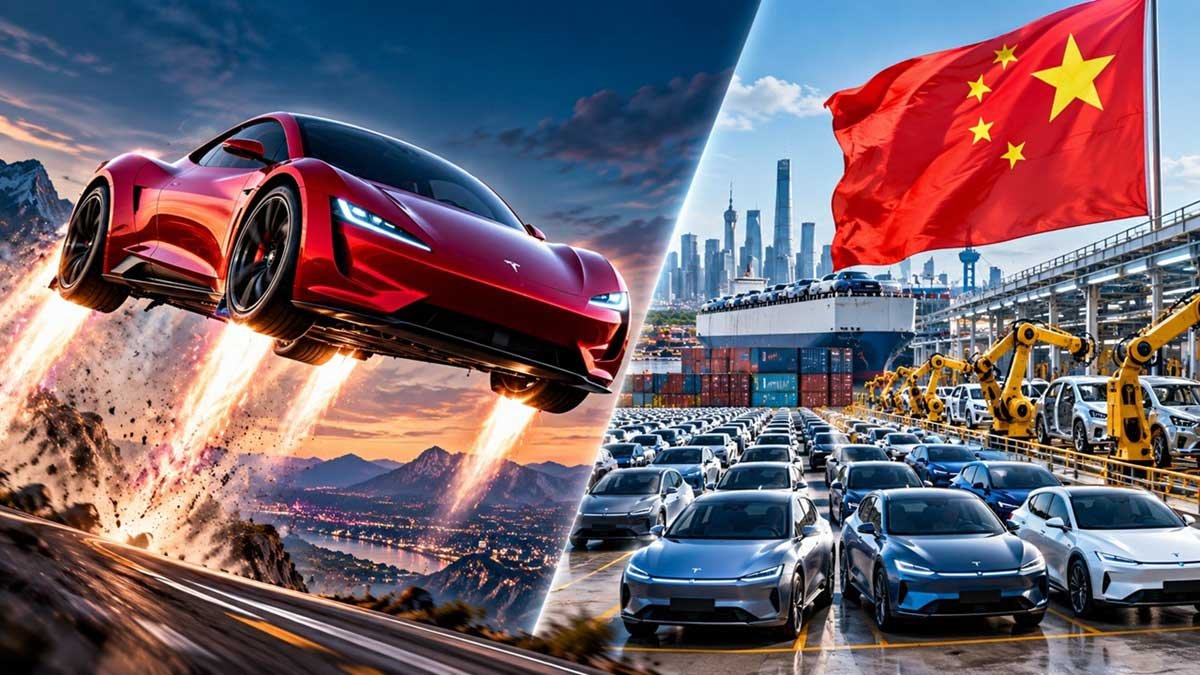
Imagine a car that can leap into the air. Now imagine a rival that can build electric vehicles for thousands of dollars less. Which one represents the future of the auto industry?
Tesla’s redesigned Roadster is designed to capture attention with futuristic engineering, extreme performance claims and SpaceX-inspired thrusters. Meanwhile, China’s electric-vehicle manufacturers are competing through manufacturing scale, battery supply chains, aggressive pricing and rapid product development.
These are two very different approaches to the future of transportation. One sells the promise of extraordinary technology. The other is reshaping how electric cars are manufactured and sold around the world.
The bigger question is whether Tesla can turn its technological ambitions into a lasting competitive advantage while Chinese automakers continue expanding their influence.
The answer may depend less on which car looks more futuristic and more on which company can deliver the right technology at the right price.
Tesla’s Flying Roadster: A Glimpse of the Future or a Marketing Masterstroke?
Tesla unveiled its redesigned next-generation Roadster on October 15, 2026, featuring a dramatic demonstration involving ramps, aerial movement and specially designed thrusters.
The company says the vehicle will incorporate technology developed in collaboration with SpaceX, Elon Musk’s aerospace company. Tesla has also announced a production target of 2028.
The concept is undeniably ambitious. Rather than competing solely on conventional performance, Tesla is attempting to push the boundaries of what a high-performance electric sports car might do.
What makes the new Tesla Roadster different?
According to Tesla’s announced specifications and demonstrations, the Roadster concept includes:
- SpaceX-inspired thrusters: Cold-gas propulsion systems intended to help the vehicle perform unusual movements.
- Extreme acceleration claims: Tesla has described configurations designed to accelerate from zero to 60 mph in less than one second.
- High-performance engineering: Active aerodynamics and other systems intended to improve vehicle performance.
- A futuristic design: A sports car that serves as a showcase for Tesla’s engineering ambitions.
These features are not all equivalent in their level of readiness. The performance figures are company claims, and a dramatic demonstration does not establish that every feature will be available in a production vehicle.
It is also important to understand what the word “flying” means here. The demonstration showed brief aerial movement, not an aircraft-like vehicle capable of sustained flight. The practicality, safety and regulatory status of the more extreme configurations remain important questions.
Tesla’s production target is another uncertainty. The next-generation Roadster was first unveiled in 2017, and earlier production expectations were repeatedly delayed.
That history does not prove the latest version will fail. It does mean that the difference between a spectacular unveiling and a commercially available vehicle deserves attention.
The central question: Can Tesla turn an ambitious demonstration into a product customers can actually buy and use?
China’s EV Industry Is Competing on a Different Battlefield
While Tesla’s Roadster attracts attention through futuristic engineering, Chinese automakers have been building a formidable position in the global electric-car industry.
The International Energy Agency’s Global EV Outlook 2026 reports that China accounted for nearly 75% of global electric-car production in 2025. Chinese manufacturers produced approximately 16 million electric cars that year, while Chinese electric-car exports more than doubled to a record level above 2.5 million.
Those figures reveal the scale of the competition. China’s advantage is not simply that it can produce individual electric cars. It has developed an extensive industrial ecosystem supporting their production.
1. Manufacturing scale can become a competitive advantage
Large production volumes can help manufacturers spread development costs, improve factory utilisation and negotiate more effectively with suppliers.
Chinese manufacturers have also developed extensive domestic supply chains. This can make it easier to coordinate vehicle design, battery production, electronics and final assembly.
However, scale alone does not guarantee success. Manufacturers must still manage quality, warranty costs, customer service, pricing pressure and demand in overseas markets.
The key point is that China’s manufacturing scale gives its automakers a substantial platform from which to compete.
2. Battery supply chains matter as much as vehicle design
Electric-car costs depend heavily on batteries and the materials used to manufacture them.
China has a particularly strong position in battery production and processing. According to the IEA, it accounted for more than 80% of global battery-cell production in 2025, alongside even higher shares of certain battery active materials.
This industrial concentration matters because battery technology influences vehicle cost, range, charging performance and manufacturing capacity.
Competitors outside China are investing in alternative supply chains, but building a comparable ecosystem takes time, capital and technical expertise.
3. Chinese manufacturers are expanding beyond their home market
Domestic competition in China has put pressure on prices and profit margins, encouraging manufacturers to pursue overseas sales.
The IEA reports that Chinese electric-car exports exceeded 2.5 million in 2025. It also identifies Southeast Asia, the Middle East and Latin America as important areas of export growth.
That expansion creates opportunities and challenges. Overseas manufacturers must adapt to different customer preferences, safety requirements, trade policies and charging infrastructure.
Chinese automakers are therefore competing not only to build vehicles efficiently but also to establish brands and distribution networks internationally.
The $11,000 EV Cost Gap: What the Numbers Actually Tell Us
One of the most striking figures in the current EV debate comes from AlixPartners, a global consulting firm.
In an October 2026 analysis of the European automotive industry, AlixPartners estimated that a Chinese-branded electric vehicle costs approximately $20,000 to produce, compared with around $31,000 for a comparable European vehicle.
That is an estimated difference of about $11,000.
The figure is important, but it needs to be interpreted carefully.
This is not a direct Tesla-versus-China comparison
The AlixPartners comparison concerns Chinese-branded EVs and comparable European vehicles. It does not establish that every Chinese EV costs $11,000 less to manufacture than a Tesla.
Production costs vary according to vehicle size, battery capacity, equipment, labour, factory utilisation, sourcing and the methodology used in a comparison.
The estimate also concerns manufacturing costs, not the final retail price a customer pays.
Nevertheless, the comparison highlights a structural challenge for established manufacturers competing with Chinese EV producers.
If one company can produce a comparable vehicle at a substantially lower cost, it may have more room to reduce prices, invest in new features or protect its margins.
That creates pressure on competitors to improve manufacturing efficiency and rethink how they design and develop vehicles.
Why lower costs can matter more than extraordinary performance
Consider two hypothetical electric cars.
| Comparison | Premium EV A | Mass-market EV B |
|---|---|---|
| Manufacturing cost | $31,000 | $20,000 |
| Selling price | $40,000 | $29,000 |
| Difference between price and manufacturing cost | $9,000 | $9,000 |
These figures are illustrative, not actual company data. They also exclude other expenses such as research and development, distribution, warranty costs, marketing and corporate overhead.
The example shows that a lower-cost manufacturer could potentially sell a vehicle at a lower price while maintaining the same difference between selling price and manufacturing cost.
For customers, a lower price can make electric vehicles more accessible. For automakers, it can help expand the potential market.
A high-performance sports car serves a different purpose. It can strengthen a brand, demonstrate engineering capabilities and attract enthusiasts, but it cannot automatically solve the cost challenges of manufacturing millions of everyday vehicles.
Tesla’s Biggest Advantage May Not Be the Roadster
It would be a mistake to judge Tesla’s competitive position solely by the new Roadster.
Tesla already operates at substantial manufacturing scale. Its Shanghai factory is a major production and export hub, and its business includes the Model 3 and Model Y rather than just specialist sports cars.
Reuters reported in July 2026 that Tesla’s Shanghai operations accounted for more than half of the company’s global deliveries in 2025, with annual production capacity exceeding 950,000 vehicles.
The company has also built a substantial charging network and developed software capabilities that form part of its broader vehicle offering.
These are meaningful competitive assets.
Tesla must translate innovation into products at scale
The important distinction is between developing impressive technology and deploying it profitably across a large vehicle lineup.
A specialised Roadster could showcase engineering advances, but its direct contribution to Tesla’s finances may remain limited compared with high-volume models.
The more consequential question is whether Tesla can use its expertise in software, electronics, manufacturing and vehicle integration to make its mass-market products more competitive.
That means improving manufacturing efficiency, maintaining quality, managing battery costs and delivering products customers want at prices they can afford.
Tesla does not need to abandon ambitious engineering. It needs to ensure that its ambitions strengthen the business that supports them.
Could Chinese EV Makers Beat Tesla in the Global Market?
China’s growing production capacity gives its automakers a major advantage, but declaring the race over would be premature.
Tesla and Chinese manufacturers compete in different ways, and their relative strengths vary by market.
Where Chinese manufacturers have an advantage
Chinese EV companies benefit from a concentrated battery ecosystem, large-scale manufacturing and intense domestic competition.
They have also demonstrated an ability to introduce new models rapidly and pursue multiple price segments.
These advantages can be especially important in markets where buyers are sensitive to upfront vehicle prices.
However, overseas expansion is not automatic. Trade restrictions, tariffs, local manufacturing requirements, brand recognition and service networks can affect how successfully a Chinese manufacturer competes in another country.
Where Tesla remains competitive
Tesla has established a recognised global brand and substantial experience manufacturing electric vehicles at scale.
Its software, charging ecosystem and vehicle integration may appeal to customers who value the overall ownership experience rather than purchase price alone.
The company can also use its manufacturing presence in different regions to serve markets and manage supply chains.
But these strengths must continue to translate into attractive products. Brand recognition does not eliminate pricing pressure, and technological ambition does not guarantee market share.
The United States is a different market
The global EV race does not play out identically in every country.
In the United States, tariffs, trade policy and restrictions affecting imported vehicles influence the competitive landscape. Chinese manufacturers cannot assume they will have the same access to American customers that they have in other markets.
That means the most important contest for Tesla in the United States may be different from the contest taking place in Europe or Southeast Asia.
The outcome will depend on domestic production, vehicle affordability, incentives and regulations, as well as consumer demand.
What Does the Flying Roadster Really Mean for the Auto Industry?
The Roadster is interesting because it represents one possible vision of the future: a vehicle that combines electric propulsion with increasingly sophisticated control systems and unconventional engineering.
But the broader EV industry is being shaped by less spectacular developments.
Battery costs, factory productivity, software development, supply-chain resilience and vehicle affordability can influence far more customers than a specialist sports car.
That does not make innovation unimportant. Breakthroughs can eventually influence other products, and high-profile vehicles can help manufacturers attract engineering talent and strengthen their brands.
The challenge is determining which innovations can be scaled economically and which are primarily demonstrations of technical possibility.
For Tesla, the Roadster may become a valuable halo product if the company delivers on its promises. For Chinese manufacturers, continued progress in manufacturing and batteries could strengthen their position across a broad range of vehicles.
Neither outcome is guaranteed.
The industry will ultimately reward companies that combine attractive products with reliable execution and sustainable economics.
The Bottom Line: The Future Belongs to More Than the Flashiest Car
Tesla’s redesigned Roadster presents a compelling vision of what a high-performance electric vehicle might become. Its thrusters and dramatic demonstrations have captured attention, but its production timeline, final specifications and practical capabilities still need to be established.
China’s EV industry presents a different kind of challenge. Its scale, battery ecosystem and manufacturing capabilities are already influencing global production and trade.
The two stories should not be reduced to a simple contest between a flying car and cheaper electric vehicles. Tesla is an established manufacturer with substantial production capabilities, while Chinese automakers are not a single company or a uniform competitive threat.
The more useful question is whether Tesla and other global manufacturers can match China’s manufacturing advantages while continuing to innovate.
The next chapter of the EV race may not be decided by which company can make the most spectacular car. It may be decided by which company can turn better technology into vehicles that more people can afford.
For consumers, that competition could eventually mean more choices, improved technology and stronger pressure on prices. For automakers, it means that innovation must be matched by execution.
The Roadster may represent an exciting vision of the future. China’s EV industry is a reminder that building the future at scale is a very different challenge.
Editorial note: Tesla’s performance specifications and production plans are company-announced claims, not guarantees of future delivery. Industry production and cost figures refer to their stated periods and comparison groups. The $11,000 cost difference is an estimate for Chinese-branded versus comparable European EVs, not a direct Tesla comparison.
Related News:






1 thought on “Tesla’s Flying Roadster Looks Like the Future. But Is China Winning the EV Race?”