
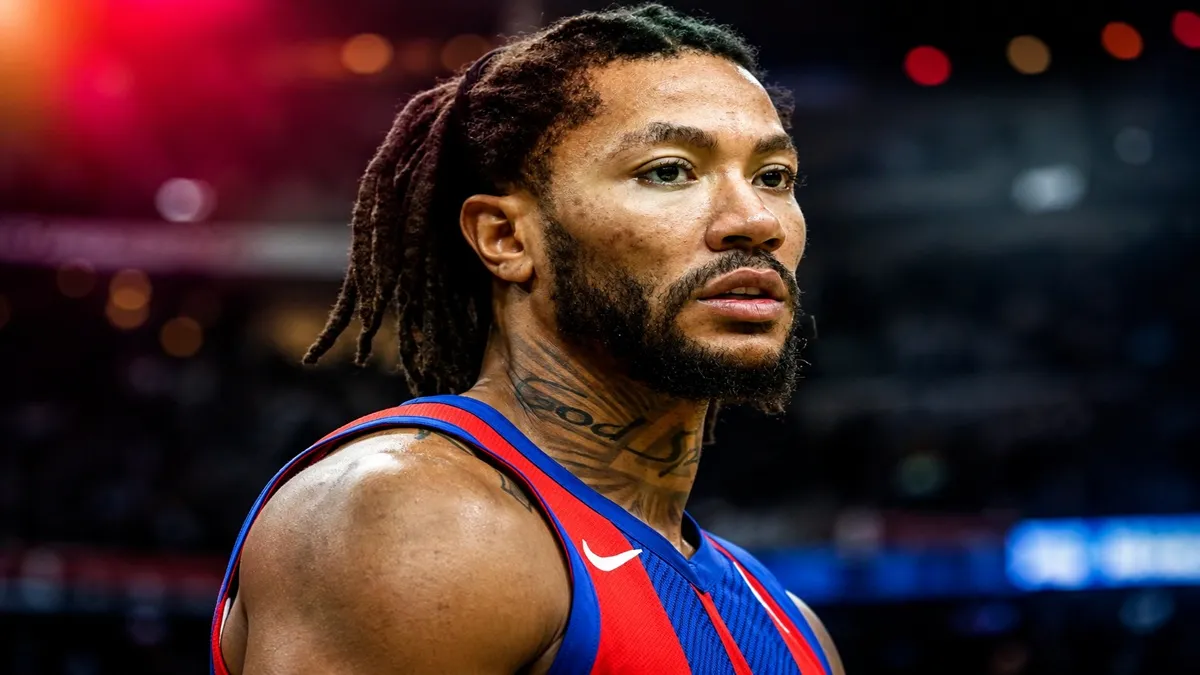
Derrick Rose went from Chicago’s hometown No. 1 pick to the youngest MVP in NBA history. Then a devastating knee injury changed the course of his career. But Rose’s story did not end there.
There was a time when Derrick Rose looked like the future of the NBA.
The Chicago Bulls selected the hometown guard with the No. 1 overall pick in the 2008 NBA Draft. One year later, he was already an NBA Rookie of the Year. By 2011, at just 22 years old, Rose had become the youngest player in NBA history to win the Most Valuable Player award.
Then came the injury that changed everything.
On April 28, 2012, Rose tore the anterior cruciate ligament in his left knee during the Bulls’ playoff opener against the Philadelphia 76ers. He was only 23 years old.
Rose eventually returned to the NBA, but he was never again the same explosive player who had dominated the league during his MVP season.
Still, calling his career a simple “fall” would miss the bigger story.
Rose spent years rebuilding his career, adjusting his playing style, changing teams and finding new ways to contribute. In 2018, he produced one of the most emotional performances of his career by scoring 50 points for the Minnesota Timberwolves.
After 16 NBA seasons, Rose retired in 2024. In 2026, the Chicago Bulls officially retired his No. 1 jersey.
Derrick Rose’s Rise to NBA Stardom
Rose grew up in Chicago and became one of the city’s most highly regarded basketball prospects. He played at Simeon Career Academy before spending one season at the University of Memphis.
The Bulls selected him first overall in the 2008 NBA Draft, bringing a Chicago native back home.
Rose immediately showed why the Bulls believed he could become a franchise star.
During his rookie season, he averaged 16.8 points, 6.3 assists and 3.9 rebounds per game. He helped Chicago reach the playoffs and won the 2008-09 NBA Rookie of the Year award.
His second season was even better, and by his third season, Rose had become one of the most dangerous offensive players in the league.
The 2011 MVP Season
The 2010-11 season remains the defining regular season of Derrick Rose’s career.
Rose averaged 25.0 points, 7.7 assists and 4.1 rebounds per game while leading the Bulls to a league-best 62-20 record.
Chicago earned the No. 1 seed in the Eastern Conference, and Rose became the centerpiece of a team that looked capable of challenging for an NBA championship.
On May 3, 2011, the NBA officially announced Rose as its Most Valuable Player.
At 22 years and 191 days old, Rose became the youngest MVP in NBA history. He received 113 of the 120 possible first-place votes from the media panel.
Rose also became only the second Bulls player to win the MVP award, joining Michael Jordan.
His 2011 playoff run was impressive as well. Rose averaged 27.1 points and 7.7 assists during 16 playoff games as Chicago reached the Eastern Conference Finals.
At that point, Rose appeared to be on the path toward a long career as one of the NBA’s elite superstars.
The ACL Injury That Changed Everything
On April 28, 2012, Chicago opened its first-round playoff series against Philadelphia.
With the Bulls leading late in Game 1, Rose attacked the basket and planted his left leg. His knee gave way.
Rose had torn his left ACL.
The injury forced him to miss the entire 2012-13 season. He was suddenly facing a long rehabilitation process at the exact stage of his career when many young superstars begin entering their physical prime.
The road back became even more difficult.
After returning in 2013-14, Rose suffered a medial meniscus tear in his right knee during a game against the Portland Trail Blazers. The injury ended his season after only 10 games.
In February 2015, Rose suffered another right meniscus tear and underwent another surgery.
These injuries fundamentally changed the trajectory of his career.
Why Derrick Rose Was Never the Same
Rose’s game before the ACL injury was built around extraordinary speed and explosiveness.
He could attack the basket with incredible acceleration, change direction quickly and finish through contact. His athleticism allowed him to put constant pressure on opposing defenses.
After multiple knee injuries, maintaining that same style became much more difficult.
That does not mean Rose stopped being talented. Instead, he had to evolve.
His role gradually changed from franchise superstar and primary offensive option to veteran scorer and playmaker.
NBA.com has noted that Rose’s prime was cut short by injuries, but he continued finding ways to contribute even after his physical game changed.
Leaving Chicago and Starting Over
After eight seasons with the Bulls, Rose was traded to the New York Knicks in 2016.
His NBA journey continued with several teams, including the Cleveland Cavaliers, Minnesota Timberwolves, Detroit Pistons, New York Knicks and Memphis Grizzlies.
The move away from Chicago represented a major change in expectations.
Rose was no longer expected to become the next face of an NBA franchise. Instead, he had to prove that he could remain a productive player in a different role.
And eventually, he did exactly that.
The 50-Point Game That Changed the Narrative
On October 31, 2018, Rose was playing for the Minnesota Timberwolves when they faced the Utah Jazz.
That night, the former MVP produced one of the greatest performances of his career.
Rose scored 50 points in Minnesota’s 128-125 victory over Utah.
He shot 19-of-31 from the field, recorded six assists and made two free throws with 13.8 seconds remaining to reach the 50-point mark.
When the game ended, Rose became emotional.
The moment carried enormous meaning because of everything he had gone through.
Just months earlier, Rose had been dealing with another injury and uncertainty about his basketball future. Now he had scored 50 points in an NBA game.
It was not the return of the 2011 MVP.
It was something different.
It was proof that Derrick Rose could still produce special moments at the highest level of basketball.
Derrick Rose Found a New Role in the NBA
Rose eventually became comfortable with a different role.
Instead of trying to recreate the player he had been at 22, he learned how to use his experience, scoring ability and playmaking to help teams from a different position.
He became a valuable veteran and a reliable offensive option off the bench.
Rose was a serious Sixth Man of the Year candidate during three consecutive seasons: 2018-19, 2019-20 and 2020-21.
Remarkably, he even received a first-place MVP vote during the 2020-21 season, a decade after winning the award himself.
That was another important chapter in Rose’s career.
He did not return to being the 22-year-old superstar who won the MVP award.
But he found a way to remain valuable in the NBA.
When Did Derrick Rose Retire?
Derrick Rose announced his retirement from professional basketball on September 26, 2024, ending a 16-year NBA career.
He finished his NBA career with averages of 17.4 points and 5.2 assists per game over 723 regular-season appearances.
According to NBA.com, Rose averaged 21 points per game before his 2012 ACL injury and 15.1 points per game in the seasons that followed.
That difference illustrates how dramatically injuries affected the second half of his career.
But his post-injury career still produced plenty of memorable moments.
He scored 50 points for Minnesota in 2018 and recorded 12 assists for Detroit against Houston in 2019, his first 12-assist game in nearly eight years.
Why Did the Bulls Retire Derrick Rose’s No. 1 Jersey?
Rose’s connection with Chicago remained strong long after he left the Bulls.
In January 2025, the Bulls announced that they would retire his No. 1 jersey during the 2025-26 NBA season.
The honor made Rose only the fifth player in franchise history to have his number retired, joining Jerry Sloan, Bob Love, Michael Jordan and Scottie Pippen.
The ceremony took place at the United Center on January 24, 2026.
Rose’s No. 1 jersey was officially raised to the rafters, marking another major moment in the legacy of the Chicago-born star.
For a player whose career was dramatically altered by injuries, the jersey retirement was a powerful acknowledgment of his impact on the Bulls and the city of Chicago.
What Really Happened to Derrick Rose?
The answer is more complicated than simply saying that Derrick Rose “fell off.”
Rose reached the highest individual level of the NBA remarkably early. At 22, he was the league’s youngest MVP. He led Chicago to 62 wins and the Eastern Conference’s best record.
Then, at 23, he suffered a devastating ACL injury.
He missed nearly two full seasons around the aftermath of that injury and later dealt with additional knee problems.
Rose was never able to return to his 2011 level of athletic dominance.
But he did something else that deserves recognition.
He kept coming back.
He changed his game. He accepted new roles. He moved from team to team. He dealt with the uncertainty that comes with repeated injuries and continued finding ways to contribute.
And in 2018, he gave basketball fans one of the most emotional moments of his career when he scored 50 points in Minnesota.
Derrick Rose’s Legacy
Derrick Rose’s career will always include a difficult question: What could he have accomplished if he had remained healthy?
There is no factual answer to that question.
What we do know is what actually happened.
Rose became the youngest MVP in NBA history.
He led the Bulls to a 62-20 record.
He suffered a devastating ACL injury at 23.
He endured multiple knee injuries and surgeries.
He returned to the NBA several times.
He scored 50 points in an unforgettable comeback performance.
He played 16 NBA seasons.
And eventually, the franchise that drafted him first overall retired his No. 1 jersey.
That is why Derrick Rose’s story should not be remembered only as the story of an MVP whose career was derailed by injuries.
It is also the story of a player who refused to let those injuries define the rest of his career.
Derrick Rose never became the player many imagined he would become in 2011. But he became something else: an NBA veteran who kept coming back until he was ready to say goodbye on his own terms.
Read This: Victor Oladipo Wants Back in the NBA at 34 — But Will Any Team Take the Risk?








1 thought on “What Happened to Derrick Rose? The Rise, Fall and Remarkable Comeback of an NBA MVP”