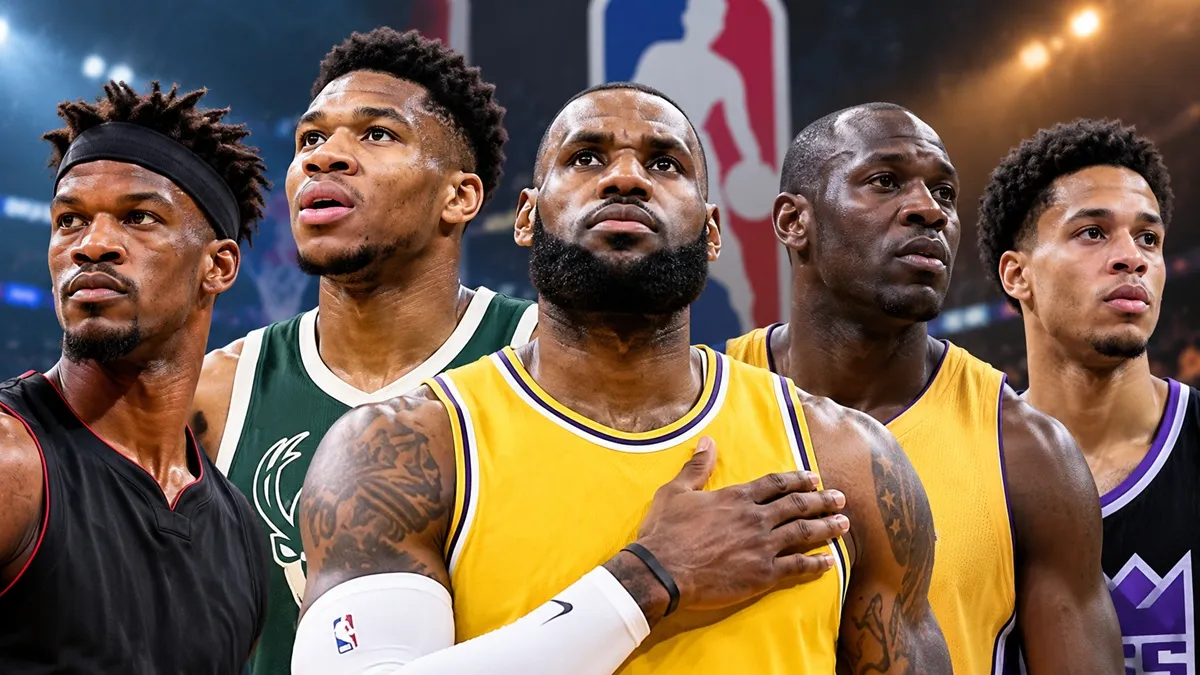
What if an NBA owner had unlimited money? Could that team simply sign five of the league’s biggest superstars and build an unstoppable roster?
At first glance, it might seem possible. NBA franchises are owned by billion-dollar businesses and some teams have shown a willingness to spend heavily on player salaries.
But the NBA does not operate like a simple “spend whatever you want” league.
The league has a salary-cap system, luxury-tax rules, and two important payroll thresholds known as the First Apron and Second Apron. These rules can dramatically change what a team is allowed to do once its payroll reaches certain levels.
For the 2026-27 season, the NBA salary cap is set at $164.961 million, while the First Apron is $209.015 million and the Second Apron is $221.686 million.
That means the most expensive NBA teams are not simply dealing with a bigger bill. They can also face additional restrictions when building their roster.
The NBA Salary Cap Is Not a Simple Spending Limit
One of the biggest misconceptions about the NBA salary cap is that teams simply cannot spend more than the cap.
That is not how the system works.
NBA teams can go above the salary cap by using different exceptions and mechanisms provided under the league’s Collective Bargaining Agreement (CBA).
For 2026-27, the official NBA salary cap is $164.961 million.
However, the league also has a minimum team salary, tax level, First Apron and Second Apron. Each level can affect how a team operates.
| 2026-27 NBA Payroll Level | Amount |
|---|---|
| Salary Cap | $164.961 million |
| Tax Level | $200.428 million |
| First Apron | $209.015 million |
| Second Apron | $221.686 million |
| Minimum Team Salary | $148.465 million |
Source: NBA official salary-cap announcement for the 2026-27 season.
So, Could a Billionaire Owner Simply Pay More?
Money is only one part of the equation.
A team can choose to spend heavily, but spending beyond certain thresholds can restrict the tools available to the front office.
This is where the NBA’s Second Apron becomes particularly important.
The Second Apron is a payroll threshold created under the current CBA. Teams above this level face additional transaction restrictions compared with teams operating below it.
In other words, the NBA system is not simply saying:
“You can spend more, but you have to pay more tax.”
It can also say:
“If you spend this much, some roster-building options are no longer available to you.”
What Is the NBA Second Apron?
The Second Apron is the highest major payroll threshold in the NBA’s current salary-cap structure.
For the 2026-27 season, it is set at $221.686 million.
The NBA has explained that teams above the Second Apron face greater transaction restrictions and penalties than teams below that level.
For example, a team above the Second Apron cannot use the Mid-Level Exception to bring in a new player. There are also restrictions on certain types of trades that could otherwise allow a high-payroll team to add more salary.
This creates an unusual situation in professional sports:
Having more money does not automatically give an NBA team more roster-building freedom.
Why the $221.7 Million Number Matters
Think about the 2026-27 salary cap of $164.961 million.
The Second Apron sits roughly $56.7 million above the salary cap.
That is a huge payroll, but it is not just the size of the spending that matters.
The important question for an NBA front office becomes:
“What do we gain by adding another expensive player, and what roster-building tools could we lose by crossing another threshold?”
This is why NBA executives have to think several moves ahead.
The Real Problem With Building a Superteam
Imagine a fictional NBA team that already has three superstar-level players on expensive contracts.
The team might have enough talent to compete for a championship, but its payroll could already be approaching one of the apron levels.
Now imagine that the front office wants to add another highly paid star.
The question is no longer simply whether the owner is willing to pay the player’s salary.
The front office must also consider:

- How much total team salary will be committed?
- Will the team cross the First Apron?
- Will it cross the Second Apron?
- Which exceptions will still be available?
- How will future trades be affected?
- Can the team continue improving the roster later?
- Will expensive contracts limit flexibility around the team’s supporting cast?
That is why the modern NBA salary-cap system has become almost as important to roster construction as the basketball itself.
The First Apron Creates Another Important Line
The First Apron is another payroll threshold above the NBA’s salary cap.
For 2026-27, the First Apron is $209.015 million.
Teams approaching this level have to consider additional restrictions under the CBA.
The First and Second Aprons therefore create two different warning lines for front offices.
A team can have an enormous payroll and still have considerable talent, but its ability to make future moves can change as that payroll moves higher.
Why NBA Front Offices Think About the Future
A superstar contract does not exist in isolation.
If one player earns a large portion of a team’s payroll, the front office has to consider how the remaining roster will be constructed.
A team still needs role players, backup players, shooters, defenders, centers, guards and other pieces that make a roster functional.
This creates one of the most interesting strategic questions in the modern NBA:
Is adding another expensive star always worth the loss of financial and roster flexibility?
There is no universal answer. It depends on the team’s roster, contracts, draft assets, competitive situation and the specific rules that apply at that point in time.
The Second Apron Was Designed to Change Team-Building Behavior
The current CBA introduced the Second Apron as a mechanism aimed at limiting some of the advantages available to the league’s highest-spending teams.
NBA executives have described the goal as creating a more balanced competitive environment by limiting certain ways that teams with extremely high payrolls can continue adding talent.
Importantly, being above the Second Apron does not mean a team is prohibited from having expensive players.
Instead, the major issue is that the team faces additional restrictions on how it can construct and modify its roster.
Does This Mean NBA Teams Cannot Have Multiple Superstars?
No.
Teams can still have multiple highly paid stars.
The rules do not establish a simple “maximum number of superstars” rule.
Instead, the CBA creates financial thresholds and transaction rules that influence how teams acquire, retain and trade players.
That distinction is important.
The NBA is not saying that a team can only have two or three stars. The system is designed so that extremely high payrolls come with additional financial and roster-building consequences.
The Hidden Cost of a Superstar Contract
When fans look at an NBA contract, they often focus on the player’s annual salary.
Front offices have to look much further ahead.
A major contract can affect:
- Future free-agent decisions
- Trade flexibility
- Salary-cap exceptions
- Roster depth
- Luxury-tax exposure
- Apron restrictions
- Future contract extensions
- Draft and roster planning
That is why a player’s salary cannot be evaluated separately from the NBA’s broader CBA rules.
The Interesting Part: More Money Can Mean Less Flexibility
This is perhaps the most counterintuitive part of the modern NBA.
Normally, more money means more choices.
In the NBA, however, crossing certain payroll thresholds can create the opposite effect.
A team can spend more money but simultaneously lose some mechanisms that could have helped it add new players.
That is the fundamental reason why the question “Why doesn’t an NBA team simply buy every superstar?” does not have a simple answer.
What This Means for NBA Fans
The next time you see an NBA team linked with an expensive superstar, the headline salary is only part of the story.
The more interesting question is where that team sits relative to the salary cap, tax level, First Apron and Second Apron.
A trade that looks financially possible on paper may have very different consequences depending on the team’s payroll position and the exact CBA rules involved.
For fans, understanding these thresholds can make NBA free agency and trade season much easier to follow.
Bottom Line
The NBA’s current financial system makes it difficult for even the richest teams to build a roster without consequences.
For the 2026-27 season, the salary cap is $164.961 million, the First Apron is $209.015 million and the Second Apron is $221.686 million.
Teams can spend above the salary cap, but the higher their payroll goes, the more important the league’s financial and transaction rules become.
So, can an NBA team simply buy five superstars?
Money alone does not answer the question.
The NBA’s salary-cap system is specifically designed so that the league’s highest-spending teams face additional restrictions when trying to add even more talent.
Sources
1. NBA.com — NBA sets salary cap for 2026-27 season at $164.961 million
2. NBA.com — NBA executives explain the Second Apron and competitive balance
3. NBA — Collective Bargaining Agreement (CBA) 101
4. NBA.com — NBA Collective Bargaining Agreement signed
Note: Salary-cap figures and league rules can change between seasons. This article uses the official NBA figures and rules applicable to the 2026-27 season.
Related News:
Kawhi Leonard’s Hall of Fame Future Could Become About More Than His Basketball Resume