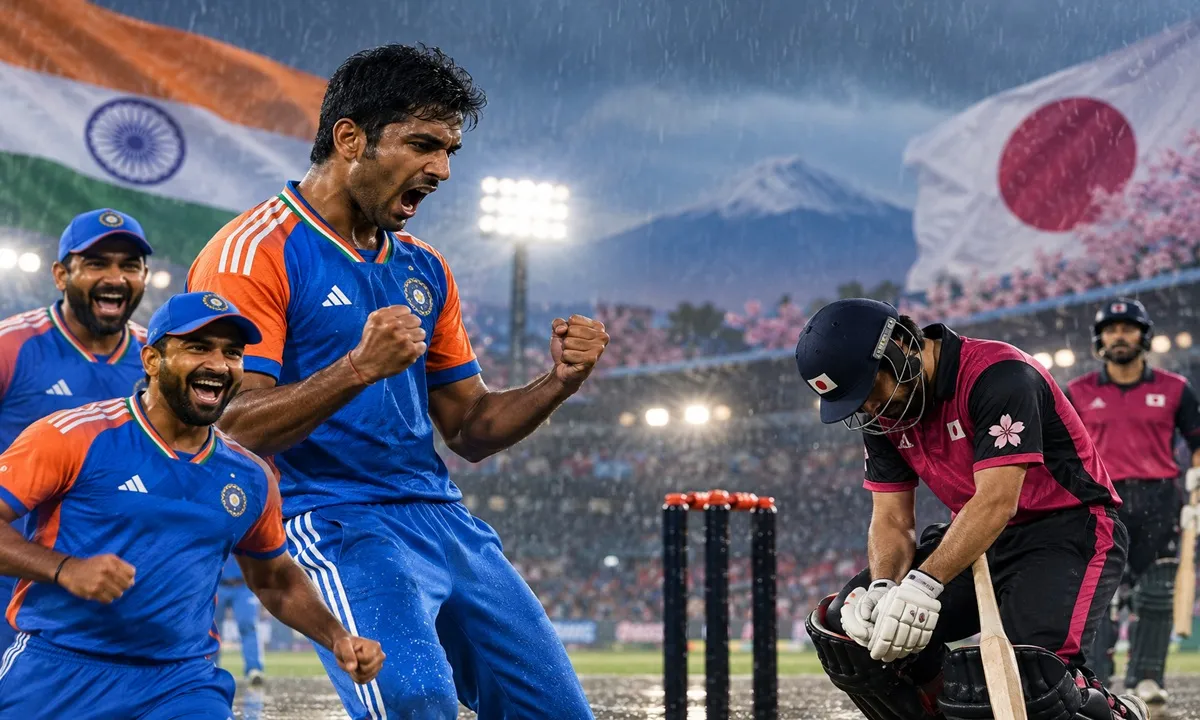
What was expected to be a historic but relatively straightforward T20I for India turned into a surprisingly tense finish after rain reduced the contest to just five overs per side at the Sano International Cricket Ground in Japan.
India posted only 32/4 from their five overs, leaving Japan with a target of 33. What followed was far more dramatic than the tiny score suggested.
Japan pushed India all the way before the visitors managed to close out the contest. With only a handful of deliveries remaining, the hosts were still within striking distance of pulling off one of the most memorable upsets in their cricketing history.
The match was shortened because of the wet conditions, turning the historic India-Japan meeting into a sprint rather than a conventional T20.
Match Summary
| Match Detail | Information |
|---|---|
| Match | India vs Japan |
| Format | T20I |
| Match Type | One-off T20I |
| Venue | Sano International Cricket Ground, Japan |
| Overs Per Side | 5 Overs |
| Reason for Reduction | Rain / Wet Outfield |
| India Score | 32/4 |
| Japan Target | 33 Runs |
| Japan Score | 27/3 after 4.2 overs |
| Runs Required | 6 runs from 4 balls |
| Result | India won |
Rain Changed Everything
The match had already faced delays because of the wet conditions. Eventually, the decision was made to reduce the game to five overs per side.
That completely changed the nature of the contest.
There was no time for batters to settle in, bowlers had almost no margin for error, and every boundary suddenly carried enormous importance.
India won the toss and opted to bat, but the shortened format did not allow their batting lineup to produce the kind of score normally expected from a T20I involving India.
India finished on 32/4 in five overs. On a normal T20 pitch, 32 would look almost insignificant. In a five-over game, however, it was a target that could create pressure—especially if Japan started quickly.
India’s 32 Suddenly Looked Vulnerable
Japan needed 33 runs to win.
The hosts did not simply collapse under the occasion. Instead, they kept the chase alive and began making India work for every wicket.
Kendel Kadowaki-Fleming, Japan’s captain and one of the team’s experienced batters, played an important role in the chase. He scored 12 from 12 balls, including a boundary, before Washington Sundar removed him at a crucial moment.
Benjamin Ito-Davis also kept the scoreboard moving, reaching 8 from seven balls as Japan continued to stay in the contest.
For a side playing India in a historic international encounter, Japan’s response made the finish far more interesting than many expected.
India’s Innings at a Glance
| India Batting | Score / Information |
|---|---|
| Total | 32/4 |
| Overs | 5 |
| Run Rate | 6.40 |
| Target Set | 33 |
| Wickets Lost | 4 |
Washington Sundar Produces the Big Moment
The turning point arrived in the fourth over.
Japan had reached 25/3, with Kadowaki-Fleming trying to keep the chase alive.
Washington Sundar delivered an important wicket when the Japanese captain attempted to play an off-break on the rise. The shot was carved towards short third man, where Yash Thakur completed the catch.
Kadowaki-Fleming departed for 12, leaving Japan with another hurdle between themselves and an extraordinary victory.
Sundar finished with 2 wickets for 13 runs from two overs, making him one of India’s key contributors in the frantic shortened contest.
Japan Refused to Give Up
The most fascinating part of the chase was that Japan continued to believe.
Earlier, Kadowaki-Fleming had attacked Ravi Bishnoi, collecting a boundary through a scoop before adding further runs. The over gave Japan valuable momentum.
The pressure then shifted rapidly from one team to the other.
At one stage, Japan were 27/3 after 4.2 overs, with the target standing at 33.
That meant six runs were required from four deliveries.
Suddenly, India’s 32 looked far less comfortable than it had at the end of their innings.
Six Runs From Four Balls: The Moment India Felt the Pressure
This was the moment that transformed the match.
India had entered the contest as the more experienced side, but a five-over game leaves almost no room for mistakes.
Japan needed only six runs from four balls. A boundary could have completely changed the equation.
Instead, India kept their composure as the closing phase of the innings arrived.
Japan’s Chase
| Japan Chase | Score / Information |
|---|---|
| Target | 33 |
| Score at 4.2 overs | 27/3 |
| Runs Needed | 6 |
| Balls Remaining | 4 |
| Match Situation | Japan within touching distance of victory |
The Scorecard That Tells the Story
| Team | Score | Overs |
|---|---|---|
| India | 32/4 | 5 |
| Japan | 27/3 | 4.2* |
Key Individual Performances
| Player | Team | Performance |
|---|---|---|
| Washington Sundar | India | 2/13 |
| Kendel Kadowaki-Fleming | Japan | 12 off 12 balls |
| Benjamin Ito-Davis | Japan | 8 off 7 balls |
| Yash Thakur | India | Catch to dismiss Kadowaki-Fleming |
The Crucial Equation
| Match Moment | Situation |
|---|---|
| India after 5 overs | 32/4 |
| Japan’s target | 33 |
| Japan after 4.2 overs | 27/3 |
| Runs required | 6 |
| Balls remaining | 4 |
| Match situation | Japan needed six runs from four balls |
Why This Was More Than Just a Win for India
The result will go into India’s record as a win, but the bigger story may be what Japan showed during those five overs.
This was a landmark occasion for Japanese cricket, with Japan facing India in a men’s international match for the first time.
Japan’s men’s team has been developing through the international pathway, and the opportunity to face India provided a major test for the country’s players.
And for a brief period in this rain-shortened thriller, Japan had India under genuine pressure.
A Historic Match Almost Became a Historic Upset
The significance of this game was never only about the final score.
India came to Japan as a major cricketing power, while Japan were experiencing a landmark international encounter against India.
Yet rain reduced the match to a five-over shootout, effectively reducing the advantage that normally comes from a longer T20 contest.
That made every ball more important.
India’s modest 32 gave Japan a realistic opportunity. Japan’s chase then created genuine tension before India’s bowlers managed to keep the hosts from completing the final push.
For India, it was a win.
For Japan, it was a memorable opportunity to test themselves against one of the biggest names in world cricket.
And for anyone watching, it was a reminder that sometimes five overs can produce more drama than 20.
India vs Japan: Match Data at a Glance
| Category | India | Japan |
|---|---|---|
| Overs | 5 | 4.2 |
| Score | 32/4 | 27/3 |
| Target | — | 33 |
| Runs Required at 4.2 Overs | — | 6 |
| Balls Remaining | — | 4 |
| Key Bowler | Washington Sundar: 2/13 | — |
Related News:
Abhishek Sharma’s 30-Ball T20I Century: The Record He Broke, and the Two Batters Still Ahead of Him