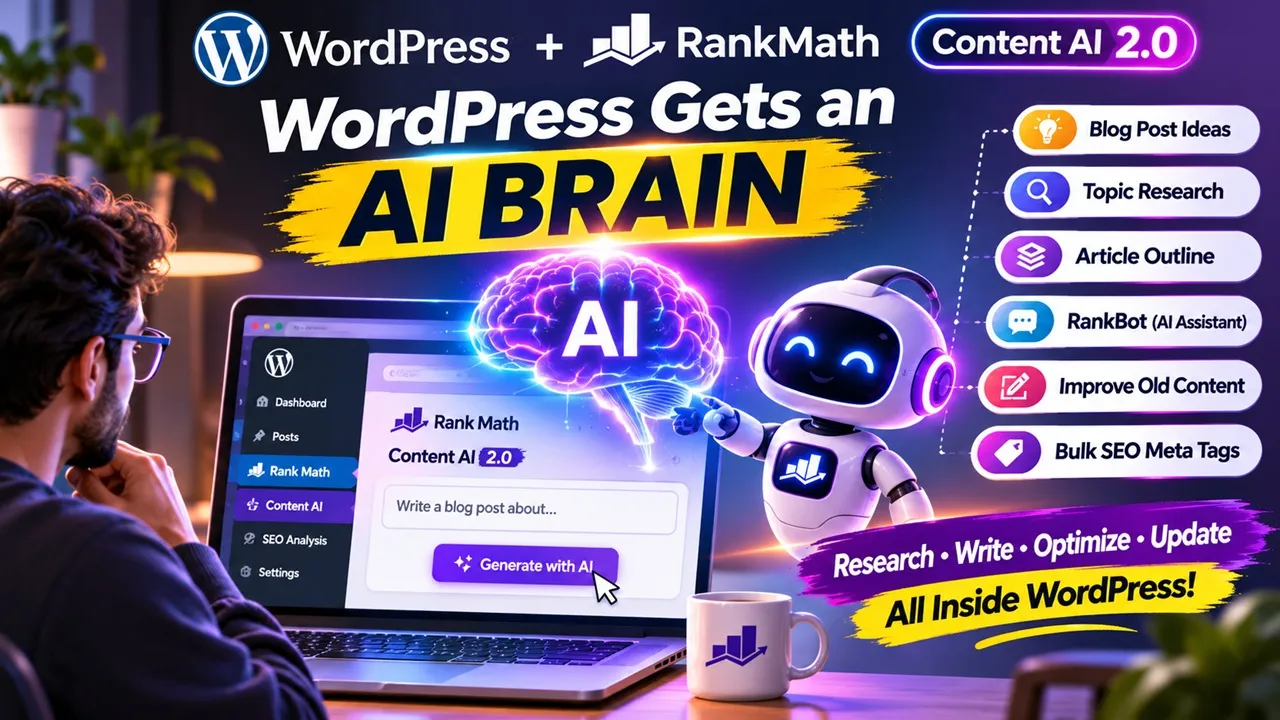
From researching topics and writing articles to fixing SEO errors and updating old posts, Rank Math’s latest AI upgrade could change how bloggers manage their websites. But its biggest impact may not be faster writing – it could be the way publishers manage their entire content operation.
For years, running a successful WordPress website has involved switching between multiple tools. A blogger might use one platform to research topics, another to generate article ideas, an AI chatbot to write drafts, and an SEO plugin to optimize everything before publishing.
Now, Rank Math wants to bring much of that process under one roof.
With the introduction of Content AI 2.0, the popular WordPress SEO plugin is expanding its AI capabilities beyond basic content generation. The upgraded platform brings together research, writing assistance, content improvement, keyword recommendations and even bulk SEO metadata generation.
At first glance, it may look like another AI writing upgrade. But a closer look reveals a much bigger ambition: making WordPress a central workspace for managing the complete content creation process.
And that could be particularly important for independent bloggers and small digital publishers.
The Biggest Change: AI Is Moving Inside the WordPress Workflow
Until now, many bloggers have followed a familiar routine.
They research a topic outside WordPress, prepare an outline using an AI chatbot, write the article in another application and finally move everything into the WordPress editor.
This process works, but constantly switching between platforms can interrupt the writing process.
Content AI 2.0 attempts to reduce that friction by integrating AI assistance directly into WordPress.
Rank Math says its upgraded Content AI works with popular editing environments, including the WordPress Block Editor, Classic Editor, Elementor and Divi. It also introduces a dedicated Content Editor where users can access multiple AI-powered tools in one place.
The idea is simple: instead of treating AI as a separate destination, make it part of the publishing environment bloggers already use.
For publishers managing several articles every week, even small improvements in workflow can make a meaningful difference.
More Than 40 AI Tools: Why This Could Matter to Small Publishers
One of the notable additions is a collection of more than 40 AI writing tools designed for different stages of content creation.
Rather than starting with a blank page, bloggers can use AI to develop an idea, research a topic and organize information into a structured outline.
The workflow begins with the Blog Post Idea tool, which can help generate potential subjects. The Topic Research tool then assists with exploring the chosen subject, while the Blog Post Outline tool helps organize the article before writing begins.
This approach addresses a common problem for independent publishers: producing a consistent flow of useful content without spending too much time on preliminary work.
However, generating more ideas does not automatically mean generating better articles.
The real advantage will depend on how effectively publishers use these tools to identify questions that existing articles have not answered.
RankBot Could Become the Most Interesting Feature
Among the new additions, RankBot deserves particular attention.
It works as an AI assistant inside the WordPress editing environment, allowing users to ask questions, gather insights and explore information related to their chosen topics.
Rank Math also highlights a prompt library containing more than 125 expert-written prompts for different niches and purposes.
This could be useful for bloggers who know their subject but struggle to decide how to approach a particular story.
For example, a technology publisher researching a new smartphone could use an AI assistant to organize questions around battery life, software support, camera performance and pricing.
A sports publisher could explore a player’s changing role, tactical performance or career statistics before deciding which angle deserves a full article.
The important distinction is that RankBot can help organize research, but its answers still need verification against reliable sources.
An AI assistant can make research faster. It cannot automatically guarantee that every fact it produces is correct.
The Feature That Could Save Bloggers Hours: Improving Old Articles
While new content creation usually receives the most attention, managing an existing article library is another major responsibility for publishers.
A website with hundreds of published posts can gradually develop outdated descriptions, weak headings, grammatical issues and missing information.
Updating every article manually can be time-consuming.
Rank Math’s new Command Center aims to make this process easier by helping users improve existing content, correct grammar and rewrite selected sections.
This is an interesting development because it shifts attention from simply publishing more articles to getting more value from content that already exists.
For example, a publisher covering smartphone launches may have older comparison articles that need updated specifications or clearer explanations.
Similarly, an entertainment website may have previously published articles that require updated release information or revised SEO descriptions.
AI-assisted editing could reduce the time needed for these improvements, although factual updates and editorial decisions must remain under human control.
Bulk SEO Meta Tags: A Practical Upgrade for Websites With Hundreds of Posts
Another potentially useful addition is the ability to generate SEO titles and meta descriptions for multiple existing articles through bulk actions.
For a small website, writing metadata for every article individually may not seem like a major challenge.
But the situation changes when a publisher manages hundreds or thousands of posts.
Some older articles may have incomplete descriptions, while others may use titles that no longer accurately represent their content.
Rank Math’s bulk metadata generation feature could help publishers review and improve these pages more efficiently.
However, automatically generated metadata should not be accepted without checking it.
A title that looks attractive to an AI system may not accurately communicate the article’s actual subject. Similarly, a generic description may fail to explain why someone should click on a particular result.
The best approach is to use AI for the first draft and editorial judgement for the final version.
Can Content AI 2.0 Replace ChatGPT or Gemini?
This is perhaps the biggest question for bloggers who already use external AI platforms.
The answer is not necessarily.
ChatGPT and Gemini are general-purpose AI assistants that can support a wide range of tasks, including brainstorming, research, analysis and writing.

Rank Math’s Content AI has a different focus: it is designed around the WordPress publishing and SEO workflow.
Its biggest attraction is convenience. Users can access AI writing and optimization features without constantly moving between applications.
But that does not automatically make it a complete replacement for other AI platforms.
A publisher may still prefer an external AI assistant for detailed comparisons, complex research, creative analysis or tasks that require specialized instructions.
In fact, combining a general-purpose AI assistant with a WordPress-focused SEO tool may be more useful than relying entirely on one platform.
The Bigger Question: Will AI Make Blogging Easier or Make Competition Tougher?
There is an interesting contradiction in the rapid growth of AI-powered blogging tools.
If more publishers can produce articles faster, the internet could become flooded with similar-looking content.
When everyone has access to tools that generate headlines, outlines and article drafts, the ability to produce text quickly may become less valuable as a competitive advantage.
The real difference will come from original reporting, useful analysis, accurate information and perspectives that readers cannot easily find elsewhere.
Google’s own guidance makes an important distinction here. It does not prohibit AI-generated content simply because AI was used. Its focus is on whether the content is helpful, original, reliable and created for people.
Google also warns against producing large volumes of unoriginal pages primarily to manipulate search rankings.
This means publishers should not mistake AI productivity for an SEO strategy.
A hundred average articles are not necessarily more valuable than ten well-researched articles that genuinely answer readers’ questions.
What This Means for the Future of Independent Blogging
Rank Math Content AI 2.0 reflects a broader change in the publishing industry.
AI tools are moving beyond individual writing tasks and becoming integrated into complete publishing workflows.
For independent bloggers, this could reduce the time spent on repetitive activities such as outlining, editing, metadata preparation and content maintenance.
It may also make advanced publishing workflows more accessible to smaller websites that cannot afford large editorial teams.
But technology alone cannot build a loyal audience.
A successful publisher still needs to understand its readers, choose relevant topics, verify information and offer something that competing websites do not.
The Future Blogger May Need Better Editorial Skills, Not Just Better AI Tools
Rank Math Content AI 2.0 is an interesting step toward bringing research, writing and SEO management closer together inside WordPress.
Its biggest potential advantage is not simply that it can generate articles faster. It is that it could help publishers manage more stages of their content operation from one environment.
For bloggers, the opportunity is clear: spend less time on repetitive tasks and more time developing original ideas, checking facts and improving the reader experience.
But there is also a warning.
When AI makes publishing easier for everyone, originality becomes even more important.
The next generation of successful bloggers may not be those who publish the most articles. They may be the ones who know how to use AI without allowing their content to sound like everyone else’s.
Related News:
Want a Budget 5G Phone This Festive Season? HMD Vibe2 Gets a Stylish New Wine Red Edition