

One of the most dramatic moments in cricket comes when a bowler appeals loudly and the umpire suddenly raises a finger. The batter looks back, the fielding team celebrates and the crowd erupts.
But what exactly happened?
Why can a batter be given out even when the ball never touches the stumps?
The answer is LBW — Leg Before Wicket, one of cricket’s most discussed and misunderstood laws.
At first glance, LBW may seem simple: the ball hits the batter’s leg and the batter is out. But that is not how the rule works. Several conditions have to be satisfied before an umpire can give a batter out LBW.
Here is the complete LBW rule explained in simple language, based on Law 36 of the MCC Laws of Cricket and current international playing conditions.
What Does LBW Mean in Cricket?
LBW stands for Leg Before Wicket.
The basic idea is that a batter cannot use their body to prevent a delivery from hitting the stumps when the delivery meets the conditions specified in Law 36.
Importantly, the law does not only refer to the leg. The ball can intercept any part of the batter’s person, subject to the other LBW conditions being satisfied.
So, calling it simply a “leg out” is actually an oversimplification.
The 5 Conditions for an LBW Dismissal
For a batter to be given out LBW, all the required conditions must be satisfied.
Think of LBW as a five-question checklist.
1. The delivery must not be a No-ball
This is the first requirement.
If the bowler delivers a No-ball, the batter cannot be dismissed LBW from that delivery.
Under the Laws, when a No-ball has been called, LBW is not among the permitted modes of dismissal.
So even if the ball appears to be crashing into the stumps after hitting the batter’s pad, the batter cannot be out LBW if it was a No-ball.
2. Where did the ball pitch?
This is where LBW starts getting interesting.
If the ball pitches before hitting the batter, its pitching location matters.
Under Law 36, the ball must first land in line between wicket and wicket or on the off side of the striker’s wicket.
A ball that pitches outside the leg-stump line cannot result in an LBW dismissal under this condition.
This is why you often hear commentators say:
“It pitched outside leg.”
That can immediately rule out an LBW dismissal.
3. Did the ball hit the batter before the bat?
This is another crucial part of the decision.
The ball must not have previously touched the bat before it intercepted the batter’s person.
In simple terms:
Bat first → generally not LBW.
Body first → LBW can still be possible, provided the other conditions are satisfied.
The 2026 edition also clarifies simultaneous contact: if the ball makes contact with the batter’s person and bat at the same time, it is considered to have touched the bat first for the purposes of this law.
That small detail can become extremely important in close DRS decisions.
4. Where did the ball hit the batter?
This is probably the part of LBW that causes the most confusion.
If the batter makes no genuine attempt to play the ball with the bat, the point of impact can be between the wickets or outside the line of the off stump.
But if the batter has made a genuine attempt to play the ball with the bat, the point of impact generally needs to be between wicket and wicket for LBW to be possible.
This is why two deliveries that appear almost identical can produce different LBW decisions.
The batter’s shot attempt matters.
5. Would the ball have hit the stumps?
This is the final question—and arguably the most important one.
The umpire must be satisfied that but for the batter’s interception, the ball would have hit the wicket.
In other words:
If the batter’s body had not been there, would the ball have hit the stumps?
If the answer is no, the batter cannot be out LBW.
This is also where ball-tracking technology becomes extremely important during a DRS review.
The Easiest Way to Remember LBW
If you want to understand LBW quickly, remember these five questions:
Was it a No-ball?
Where did it pitch?
Did it hit the bat first?
Where did it hit the batter?
Would it have hit the stumps?
If the required conditions are satisfied, the batter can be given out LBW.
If one of the necessary conditions fails, the LBW appeal can be rejected.
Why Does “Outside Leg” Mean Not Out?
This is one of the most common questions among cricket fans.
Imagine a right-handed batter facing a delivery that pitches well outside the batter’s leg stump.
The ball then swings back and hits the batter’s pad.
Even if ball tracking shows that the ball would have gone on to hit the stumps, LBW is not possible if the ball first pitched outside the leg-stump line.
That is because the pitching requirement in Law 36 has not been satisfied.
This is one reason why the phrase “pitched outside leg” can instantly end an LBW discussion.
What If the Ball Pitches Outside Off?
A ball pitching outside off stump can still result in an LBW dismissal.
But the other conditions must also be satisfied.
For example, if the batter makes a genuine attempt to play the ball and misses it, the ball can still produce an LBW decision if the impact and projected path satisfy the law.
If the batter makes no genuine attempt to play the ball, the law allows a wider range for the point of impact, including outside the off-stump line, provided the other conditions are met.
This is why the batter’s intent and shot attempt can become important in an LBW decision.
Can the Ball Be Above the Stumps and Still Be LBW?
Yes.
The Law specifically says that the point of impact can be considered even if it is above the level of the bails.
The important question is not simply whether the pad was above the stumps.
The question is whether the ball, had it not been intercepted, would have hit the wicket.
This is another reason why LBW decisions cannot always be judged simply by looking at where the ball struck the batter.
What Happens When the Ball Hits Bat and Pad Together?
This is where modern technology and slow-motion replays can become fascinating.
The 2026 edition of the Laws provides a specific clarification: when the ball contacts the batter’s person and bat simultaneously, it is considered to have first touched the bat for the purpose of Law 36.
Therefore, a batter cannot be given out LBW simply because the ball appears to have hit the pad and bat at almost exactly the same moment.
The order of contact matters.
Does the Fielding Team Have to Appeal?
Yes.
An umpire does not simply give a batter out because the conditions for a dismissal appear to exist.
Under Law 31, an umpire cannot give a batter out unless the fielding side appeals, although a batter may leave the wicket without an appeal in the circumstances described by the Law.
That is why you see the bowler, wicketkeeper and fielders immediately shouting:
“How’s That?”
The appeal is effectively asking the umpire to make a dismissal decision.
The MCC also states that the traditional appeal “How’s That?” covers all ways of being out.
How Does DRS Check an LBW Decision?
When an LBW decision is reviewed, the third umpire follows a sequence of checks.
The process includes determining whether the delivery was fair, whether the ball touched the bat before the batter’s person, and then assessing the relevant pitching, impact and wicket-related information.
Ball-tracking technology is then used to help determine what would have happened to the delivery.
The technology effectively answers the biggest LBW question:
If the batter had not been there, would the ball have hit the stumps?
But DRS is not simply about the final projected path. The pitching and impact conditions under the LBW law must also be satisfied.
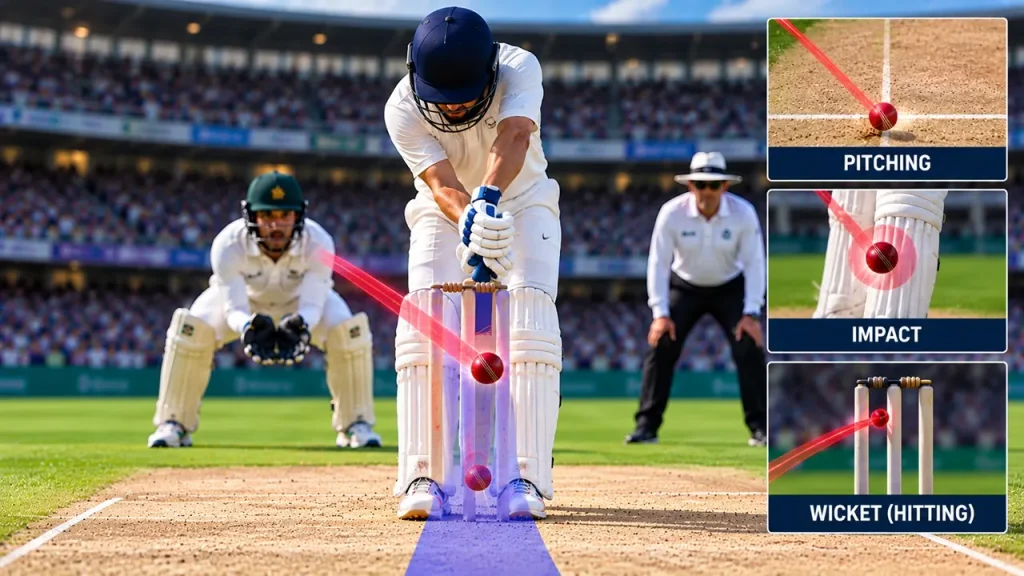
A Simple LBW Example
Imagine a fast bowler delivers a straight ball to a right-handed batter.
The batter tries to play a defensive shot but misses.
The ball:
- is not a No-ball;
- pitches between the wickets;
- hits the batter’s pad before the bat;
- hits the batter in line with the stumps; and
- would have hit the stumps if the pad had not been there.
In this situation, the batter can be given out LBW.
Now change just one thing.
Suppose the same ball pitched outside the batter’s leg stump.
Even if ball tracking predicts that it would have hit the stumps, the batter would not be out LBW because the pitching requirement has failed.
That is the beauty—and complexity—of LBW.
Why Do Some LBW Decisions Look So Confusing?
Because an LBW decision is not based on just one factor.
The umpire has to consider a chain of events:
Delivery → Pitching → First Contact → Impact → Projected Path
A tiny difference in any one of these can change the outcome.
A ball can:
- pitch outside leg and be Not out;
- hit the bat first and be Not out;
- hit the batter outside the relevant impact area and be Not out;
- miss the stumps in projection and be Not out;
even though the batter’s pad may appear to be directly in front of the wicket.
That is why LBW remains one of cricket’s most technically fascinating dismissals.
LBW vs Bowled: What’s the Difference?
The simplest difference is this:
Bowled: The ball actually breaks the wicket, subject to the conditions of the Bowled law.
LBW: The batter’s body intercepts the ball and, under the conditions of Law 36, the ball would otherwise have hit the wicket.
So in an LBW dismissal, the stumps do not have to be physically hit.
The law essentially asks what would have happened but for the batter’s interception.
Why Is LBW Called “Leg Before Wicket”?
The name comes from the basic concept of a batter’s body coming between the ball and the wicket.
However, modern Law 36 is more precise than the name suggests because it refers to the ball striking any part of the batter’s person, not merely the leg.
So “LBW” is the traditional name, but the actual law is much more detailed.
Quick LBW Checklist
| Question | What it means |
|---|---|
| Was it a No-ball? | If yes, no LBW |
| Where did it pitch? | Outside leg means LBW is not possible |
| Did it hit the bat first? | If yes, LBW is not possible |
| Where was the impact? | The batter’s shot attempt matters |
| Would it hit the stumps? | If no, Not out LBW |
| Was there an appeal? | An umpire normally cannot give out without one |
The exact application of the law depends on the circumstances of the delivery and the applicable playing conditions.
LBW may look like a simple case of a ball hitting a batter’s pad, but the actual law is far more precise.
For an LBW dismissal, cricket officials have to consider the legality of the delivery, where the ball pitched, whether it touched the bat first, where it hit the batter and whether it would have gone on to hit the wicket.
And that is exactly why an LBW appeal can turn into one of the most suspenseful moments in a cricket match.
The next time you hear a huge “How’s That?” appeal, don’t just look at the batter’s pad.
Look at the pitching, impact and projected path.
That’s where the real LBW story is.
Frequently Asked Questions
Q. What does LBW stand for in cricket?
LBW stands for Leg Before Wicket.
Q. Can a batter be LBW if the ball pitches outside leg stump?
No. Under Law 36, if the ball pitches outside the leg-stump line, the batter cannot be dismissed LBW.
Q. Can LBW be given on a No-ball?
No. A batter cannot be dismissed LBW from a No-ball.
Q. Does the ball have to hit the leg for LBW?
No. The law refers to the ball intercepting any part of the batter’s person, subject to the other LBW conditions.
Q. Why is DRS used for LBW?
DRS can help officials determine details such as whether the ball touched the bat first, where it pitched and where the ball was projected to go.
Q. Does the fielding team have to appeal for LBW?
Yes. Under Law 31, an umpire normally cannot give a batter out unless the fielding side has appealed.
Related News:
India Create T20I History: From Their First Win in 2006 to 200 Victories in 2026






1 thought on “Why Is a Batter Out LBW? Cricket’s Most Misunderstood Rule Explained”