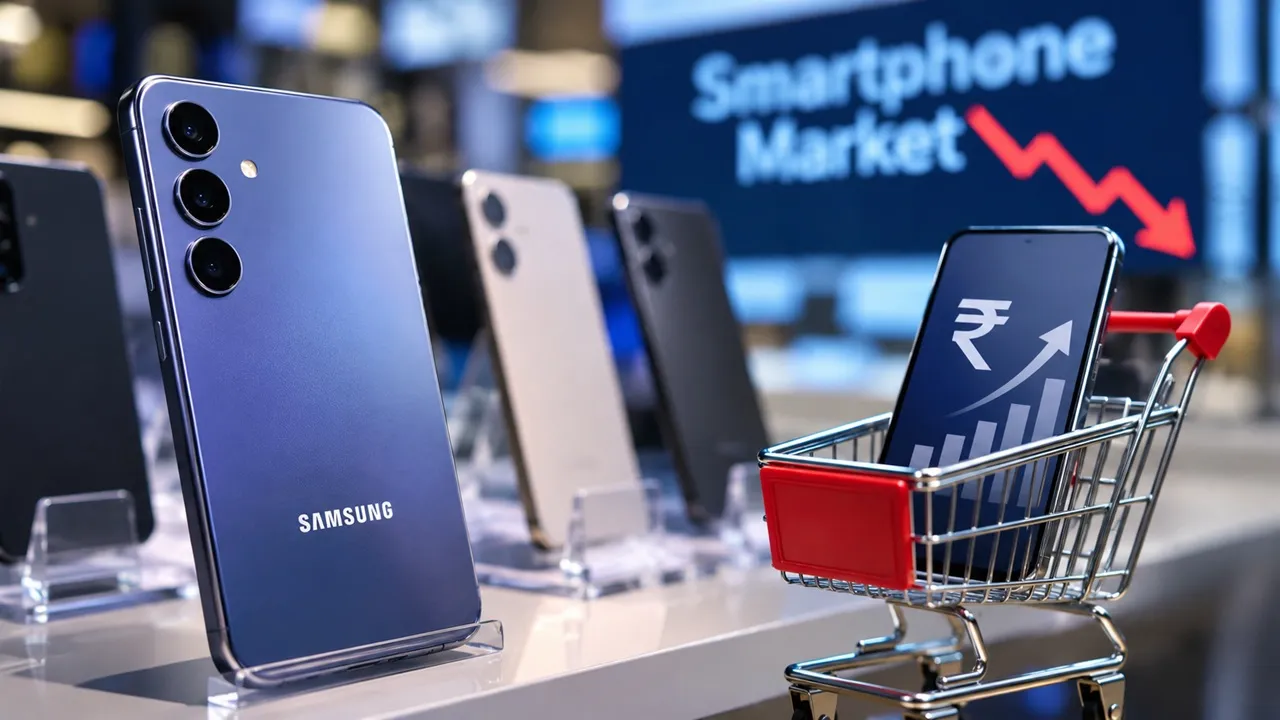
India’s smartphone market is going through a major shift, and it could directly affect people planning to buy a new phone. Even the festive season, traditionally one of the strongest periods for smartphone sales, failed to bring the expected momentum in 2026.
According to the latest data from market research firm IDC, smartphone shipments in India dropped 23.3% year-on-year to 36.8 million units in the July–September quarter of 2026. This was the weakest festive quarter in a decade.
But the biggest concern is not simply that fewer smartphones are reaching the market. It is that affordable smartphones are becoming increasingly difficult for manufacturers to produce and sell profitably.
For millions of consumers looking for a reliable smartphone on a tight budget, this could mean fewer choices, higher prices and longer waiting periods before upgrading.
The Biggest Warning: Budget Smartphones Are Disappearing
One of the most striking findings in IDC’s report is the collapse of smartphones priced below $100.
Shipments in this price category fell by a massive 90.9% year-on-year, reaching just 700,000 units in Q3 2026.
Its share of India’s smartphone market dropped from 16.2% to only 1.9%.
This is significant because entry-level smartphones have traditionally helped first-time buyers, students and people looking for affordable secondary devices enter the smartphone market.
| Smartphone market indicator | Q3 2025 | Q3 2026 | Change |
|---|---|---|---|
| Overall smartphone shipments | — | 36.8 million | -23.3% |
| Phones below $100 | — | 0.7 million | -90.9% |
| Below-$100 market share | 16.2% | 1.9% | -14.3 percentage points |
| Average selling price | — | $371 | +26.1% |
| Overall market value | — | — | -3.3% |
Source: IDC Worldwide Quarterly Mobile Phone Tracker, November 2026.
The message is clear: the cheapest segment is facing the strongest pressure. Manufacturers are finding it harder to maintain attractive specifications at the lowest price points as component costs increase.
Why Are Smartphones Becoming More Expensive?
The biggest reason behind the slowdown is rising memory chip costs.
Modern smartphones require memory components such as DRAM and NAND storage. Demand for these components has increased as AI infrastructure and data centres consume more supply.
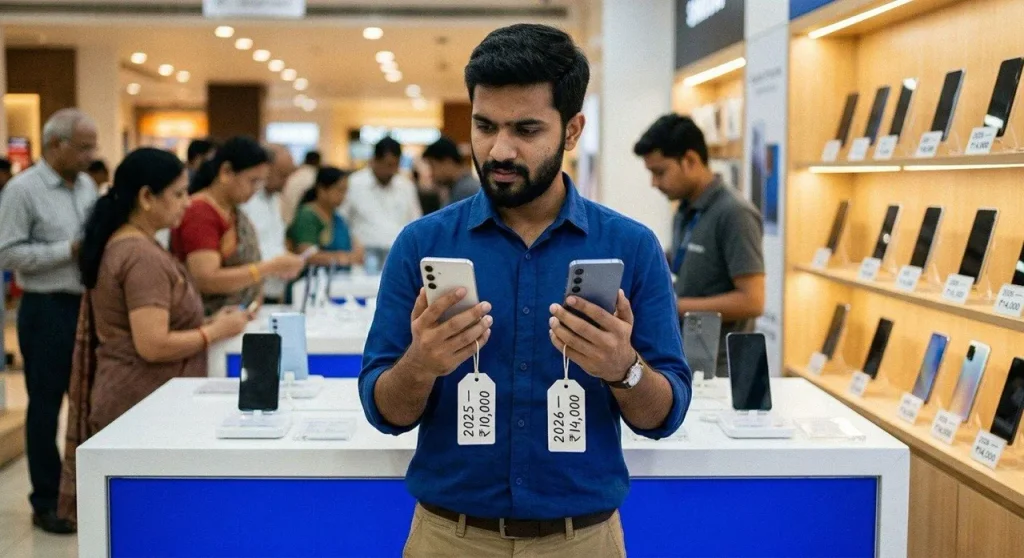
This has created cost and availability pressure across the electronics industry.
Smartphone manufacturers now have fewer options. They can increase retail prices, reduce promotional discounts or make compromises in specifications.
For consumers, this could translate into:
- Higher prices for smartphones with the same storage capacity.
- Fewer attractive festive and online sale discounts.
- Limited availability of entry-level models.
- More expensive RAM and storage configurations.
- Greater emphasis on EMI and exchange offers.
This also explains why the average smartphone selling price increased 26.1% to a record $371, even as total market shipments declined.
Samsung Is Winning While Almost Everyone Else Is Losing
There is another important development in the latest market report.
Samsung has returned to the number-one position in India after 10 quarters, overtaking Vivo.
More importantly, Samsung was the only brand among IDC’s top 10 to record year-on-year shipment growth in Q3 2026.
Here is how the leading smartphone brands performed:
| Brand | Market Share Q3 2025 | Market Share Q3 2026 | Shipment Growth |
|---|---|---|---|
| Samsung | 12.6% | 17.7% | +7.9% |
| Vivo | 18.3% | 16.8% | -29.9% |
| OPPO | 13.9% | 13.3% | -26.5% |
| Apple | 10.4% | 10.1% | -25.0% |
| Motorola | 8.3% | 8.8% | -18.4% |
| Xiaomi | 9.2% | 8.3% | -31.1% |
| realme | 9.8% | 7.7% | -39.8% |
| POCO | 4.3% | 4.5% | -20.6% |
| OnePlus | 2.4% | 2.7% | -14.5% |
| iQOO | 3.3% | 1.9% | -56.5% |
Source: IDC. Market shares are rounded.
Samsung’s shipment growth of 7.9% is particularly notable in a market where competitors experienced double-digit declines.
Its more controlled price increases during the first half of 2026, wider product portfolio and stronger ability to manage supply helped the company maintain its position.
However, Samsung’s return to the top should not be confused with overall market growth. The entire market is shrinking, even as the company gains share.
Apple Also Faces Pressure: iPhone Shipments Fall 25%
Apple’s performance offers another interesting example of how even premium brands are not completely protected from market pressure.
IDC reported that Apple’s iPhone shipments declined 25% year-on-year in Q3 2026.
The company faced supply shortages affecting the iPhone 15, iPhone 16 and iPhone 17 ranges. Reduced discounts on older models and price increases around September launches also affected demand.
Interestingly, the iPhone 18 Pro and iPhone 18 Pro Max accounted for more than 30% of Apple’s shipments during the quarter.
This suggests that premium demand still exists, but the market is becoming more selective.
Online Shopping Is Holding Up Better Than Offline Retail
Another important finding is the difference between online and offline smartphone distribution.
Offline smartphone shipments fell 26.7%, while online shipments declined 18.9%.
| Sales Channel | Market Share Q3 2025 | Market Share Q3 2026 | Shipment Change |
|---|---|---|---|
| Offline retail | 56.4% | 53.9% | -26.7% |
| Online retail | 43.6% | 46.1% | -18.9% |
Online channels performed relatively better, although they also experienced a decline.
One possible reason is that consumers can easily compare prices, specifications, bank offers and exchange benefits across online platforms.
Meanwhile, offline retailers faced weaker restocking as higher prices and limited festive discounts reduced purchasing interest.
What Does This Mean for People Planning to Buy a Smartphone?
The latest figures do not mean every smartphone will immediately become more expensive. They do, however, highlight a market where affordability and availability are becoming major concerns.
If you are planning to buy a smartphone, consider these points:
1. Do not choose a phone based only on its launch price.
Compare the actual selling price, storage configuration, software support and available offers.
2. Compare exchange and EMI offers carefully.
A lower monthly EMI does not automatically mean a better deal. Check the total amount payable and the value of your old device.
3. Think about long-term usage.
If your current phone still performs well, there may be no reason to upgrade immediately. Battery health, security updates and repair costs should also influence your decision.
4. Check stock before waiting for a major sale.
If affordable models become harder to source, the best deal may not necessarily arrive during the next major shopping event.
Will Smartphones Become Even More Expensive in 2027?
The near-term outlook remains challenging.
IDC expects India’s smartphone shipments to decline by more than 25% year-on-year in Q4 2026. It also forecasts full-year 2026 shipments of 125–127 million units, representing a decline of 16–18% compared with 2025.
The company expects market growth to remain constrained through 2027, with a meaningful recovery potentially not arriving before 2028.
The most important factors to watch will be memory component prices, the availability of affordable smartphones, financing schemes and consumer willingness to replace older devices.
For manufacturers, the challenge will be to offer meaningful improvements without pushing prices beyond what ordinary buyers can afford.
The Bigger Picture: India’s Smartphone Market Is Changing
India has long been one of the world’s most important markets for affordable smartphones. But the latest IDC figures suggest that the traditional low-price strategy is facing serious pressure.
The market is gradually shifting towards higher-priced devices, while the cheapest segment is losing ground.
Samsung has managed to benefit from this changing environment, while several competitors are struggling to maintain shipment volumes.
For consumers, the biggest question is no longer simply which company sells the most smartphones.
It is whether manufacturers can continue offering reliable smartphones at prices that ordinary Indian buyers can afford.
And that may become the defining challenge for India’s smartphone industry over the next two years.
Reporting note: Shipment figures represent devices shipped into distribution channels, not confirmed purchases by individual consumers. Market-share and shipment data should therefore not be interpreted as direct retail sales figures.
Related News:
WordPress Is Getting an AI Brain: Could Rank Math Content AI 2.0 Change the Future of Blogging?